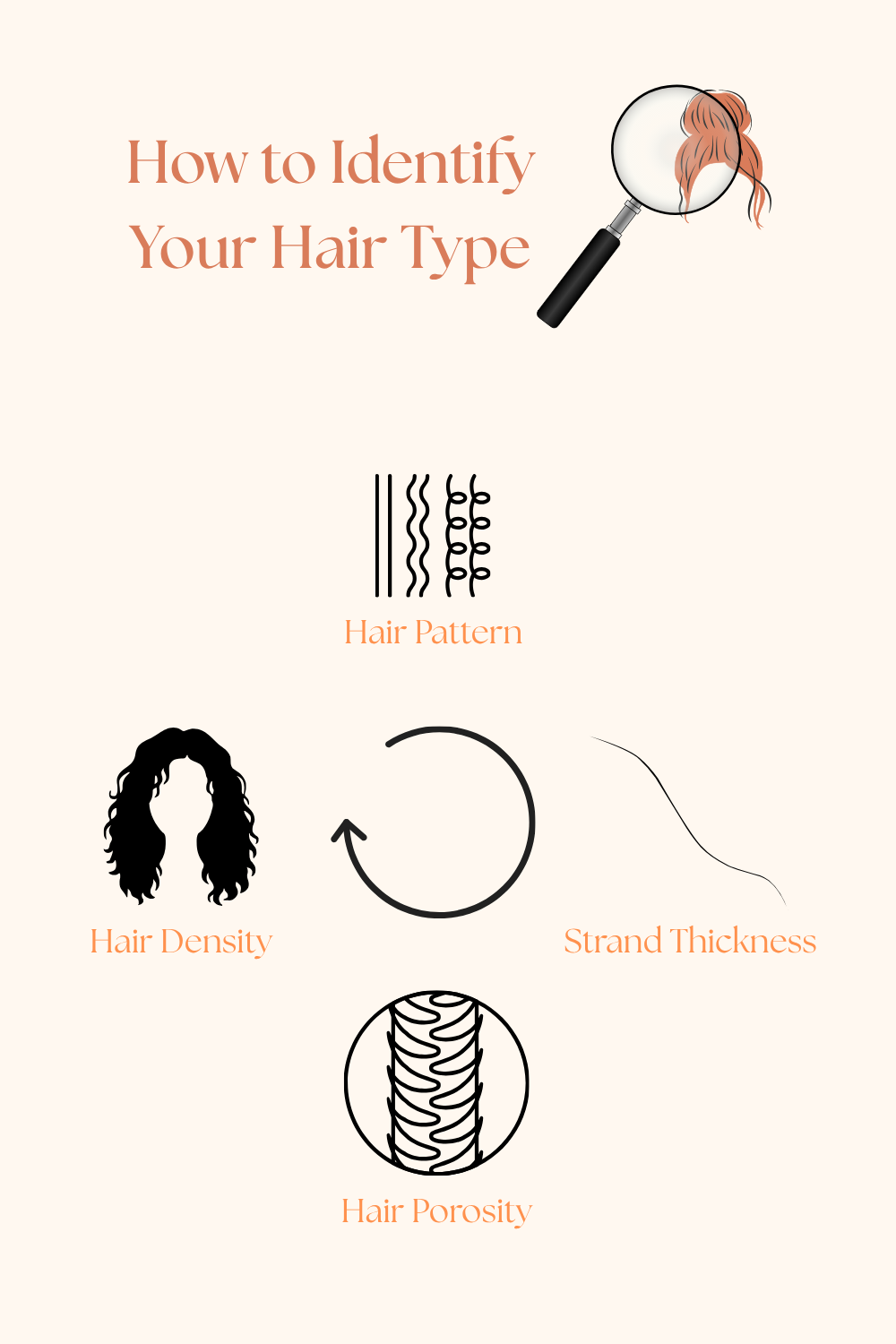
Understanding your hair type is the first step toward achieving healthy, beautiful hair. Whether you have straight locks, bouncy waves, or tight curls, knowing your hair type helps you pick the right products, styles, and care routine that your hair truly needs.
Step 1: Determine Your Hair Texture
Hair texture refers to the thickness of individual strands. There are three main categories:
-
- Fine Hair: Thin strands that can feel soft or silky but are prone to breakage and oiliness.
-
- Medium Hair: The most common type; strands are neither too fine nor too thick and hold styles well.
-
- Coarse Hair: Thick strands that are strong but can be dry or frizz-prone.
Tip: Take a single strand and roll it between your fingers. If it feels thin and delicate, it’s fine; if it feels thick and sturdy, it’s coarse.
Step 2: Identify Your Hair Pattern
Hair pattern describes the natural curl or wave of your hair. The most popular system is the Andre Walker Hair Typing System, which classifies hair from type 1 to type 4:
-
- Type 1 – Straight Hair: No curl or wave, smooth and shiny.
-
- Type 2 – Wavy Hair: Slight bend in hair, ranges from loose “S” waves to more defined waves.
-
- Type 3 – Curly Hair: Clearly defined curls, springy and bouncy.
-
- Type 4 – Coily/Kinky Hair: Very tight curls or zig-zag patterns, often dense and fragile.
Tip: Look at your hair when it’s dry and without any product. The natural pattern is easiest to see.
Step 3: Check Hair Porosity
Hair porosity affects how well your hair absorbs and retains moisture.
-
- Low Porosity: Hair repels water, products sit on top. Feels stiff or resistant.
-
- Medium/Normal Porosity: Hair absorbs moisture easily and styles hold well.
-
- High Porosity: Hair absorbs water quickly but loses it fast, prone to frizz and dryness.
Quick Test: Place a strand in a glass of water. If it floats for a long time, it’s low porosity. If it sinks slowly, it’s medium. If it sinks fast, it’s high.
Step 4: Determine Hair Density
Density refers to how many strands grow on your scalp. Look at your scalp in natural light:
-
- Thin: Scalp is easily visible.
-
- Medium: Scalp is slightly visible.
-
- Thick: Scalp barely visible due to high strand count.
Step 5: Identify Your Hair Needs
Once you know your hair type, you can choose the right routine and products:
-
- Fine Hair: Lightweight shampoos, avoid heavy oils.
-
- Curly Hair: Moisturizing shampoos, leave-in conditioners, and curl creams.
-
- High Porosity Hair: Deep conditioning treatments, protein-rich products.
-
- Low Porosity Hair: Lightweight oils, avoid buildup with clarifying shampoos.
Bonus Tips:
-
- Avoid over-washing; it can damage your natural curl pattern.
-
- Trim regularly to keep ends healthy.
-
- Experiment with products until you find the perfect match for your hair type.
Conclusion:
Identifying your hair type is more than a label—it’s the key to understanding what your hair loves and what it doesn’t. Take the time to observe your hair’s texture, pattern, porosity, and density. Once you do, caring for it becomes much easier, and you’ll be on your way to stronger, healthier, and more beautiful hair.